
Hay una idea en marcha que me parece técnicamente muy sólida: constelaciones de satélites con cadencia suficientemente alta como para hacer seguimiento continuo del estado de la vegetación a escala de parcela. No hablo de Sentinel o Landsat, con revisitas de varios días o semanas, sino de arquitecturas que permiten observar el mismo punto con una cadencia mucho mayor. Cuando eso se cruza con gestión ganadera y agricultura el caso de uso se vuelve muy concreto.
Category Archives: ideas
Topografía desde el espacio: flujo completo de InSAR para generar un DTM con Sentinel-1
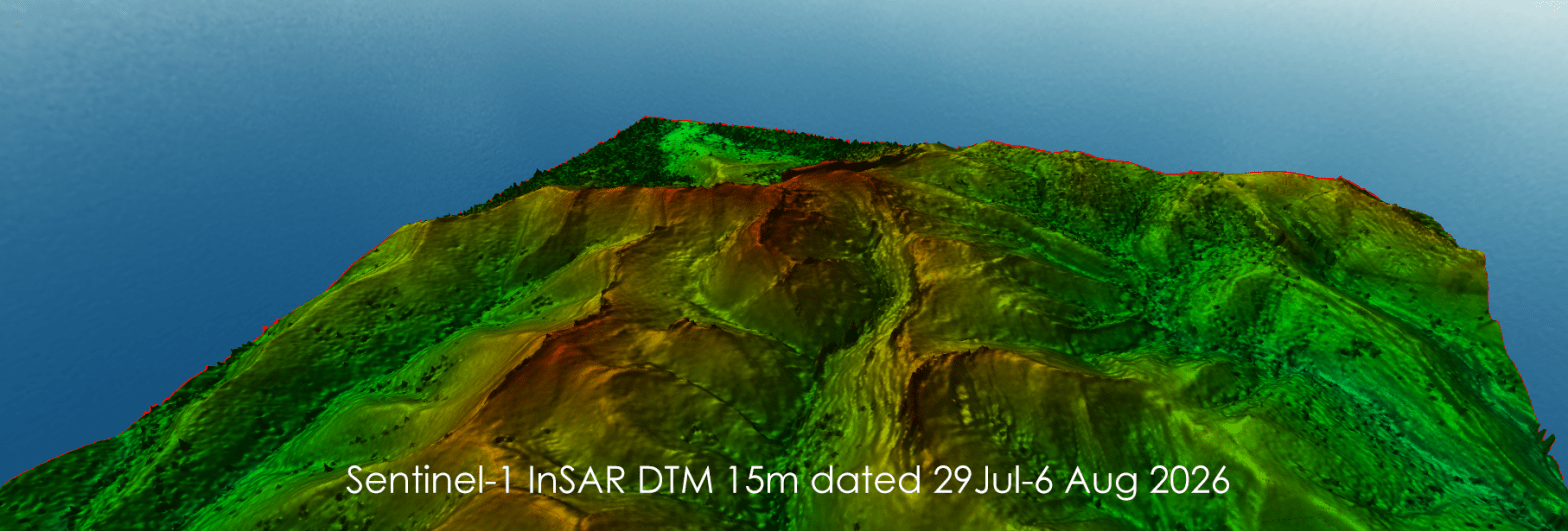
Hay una pregunta que me ronda desde hace tiempo: ¿hasta qué punto puede un analista GIS, sin presupuesto de misión espacial ni acceso a LiDAR propio, generar un Modelo Digital del Terreno con una precisión que supere a los DEM globales de libre acceso? La respuesta corta: sí se puede, pero el camino no es trivial. Este post documenta ese camino completo, con todos sus tropiezos incluidos, porque creo que el valor real de un tutorial está tanto en lo que sale bien como en lo que se rompe por el camino.
Geografía financiera de Castilla y León · análisis espacial de POIs Open Data 2026
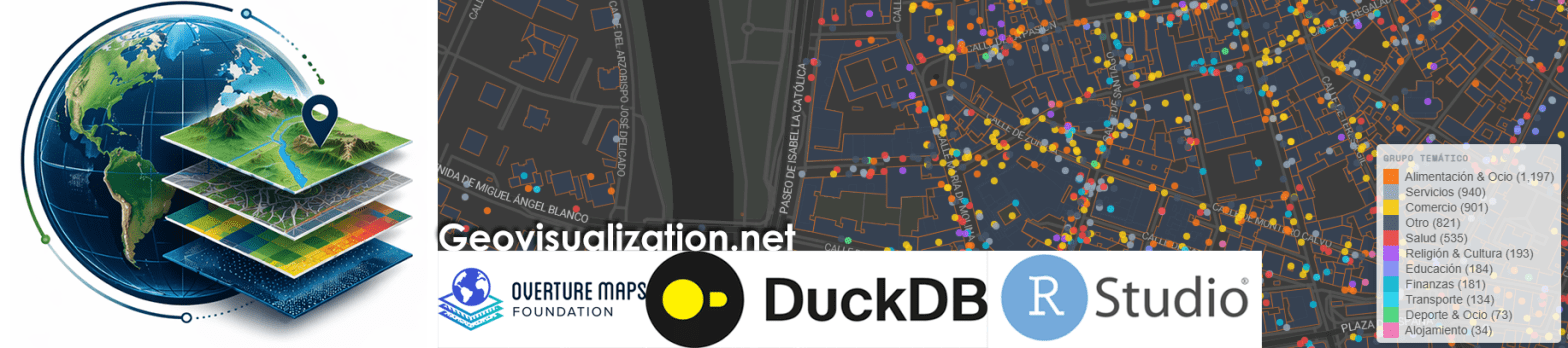
El análisis de la distribución espacial de servicios financieros en centros urbanos —bancos, cajeros, aseguradoras, gestorías y corredurías de seguros— ofrece una lectura directa de la vitalidad económica y la accesibilidad financiera de un territorio. Mapear estos puntos con assetIQ sobre datos Overture Maps permite identificar en minutos dónde se concentra la actividad financiera, qué zonas quedan en la periferia del servicio y cómo se estructuran los ejes comerciales de cada ciudad. El mismo análisis es replicable para cualquier otra capa temática —alojamiento, salud, restauración, deporte— convirtiendo cada capital de provincia en un dashboard geoespacial comparable y reproducible.
El kernel que sigue al fuego: reconstruyendo el pulso de un fuego con datos satelitales
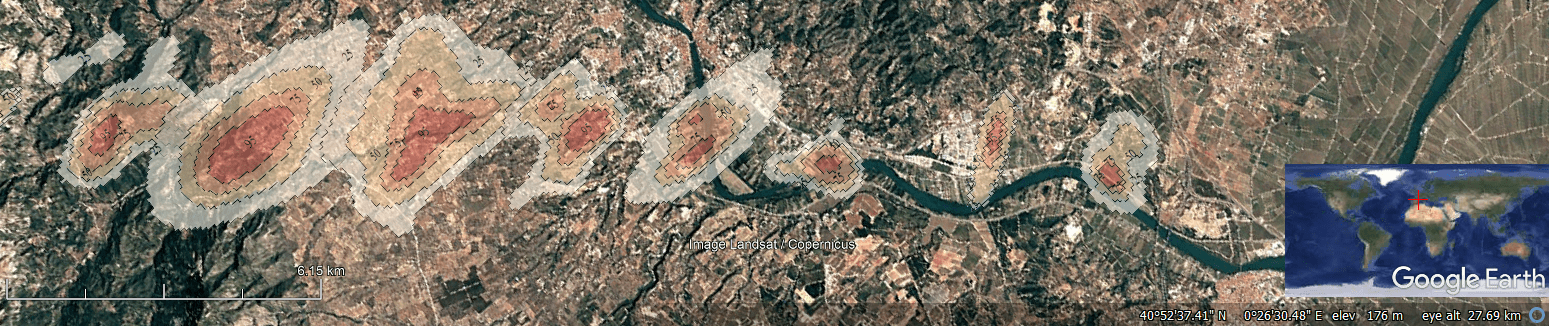
He pasado los últimos días construyendo Fire Kernel Tracker, una app en R Shiny que representa el ciclo de vida completo de un incendio forestal: desde el primer foco hasta la extinción, usando un kernel de densidad espacio-temporal ponderado por FRP (Fire Radiative Power) sobre detecciones satelitales VIIRS/MODIS de NASA FIRMS.
De NDVI a CO2e: un pipeline MRV de estimación de emisiones FLAG con GEE
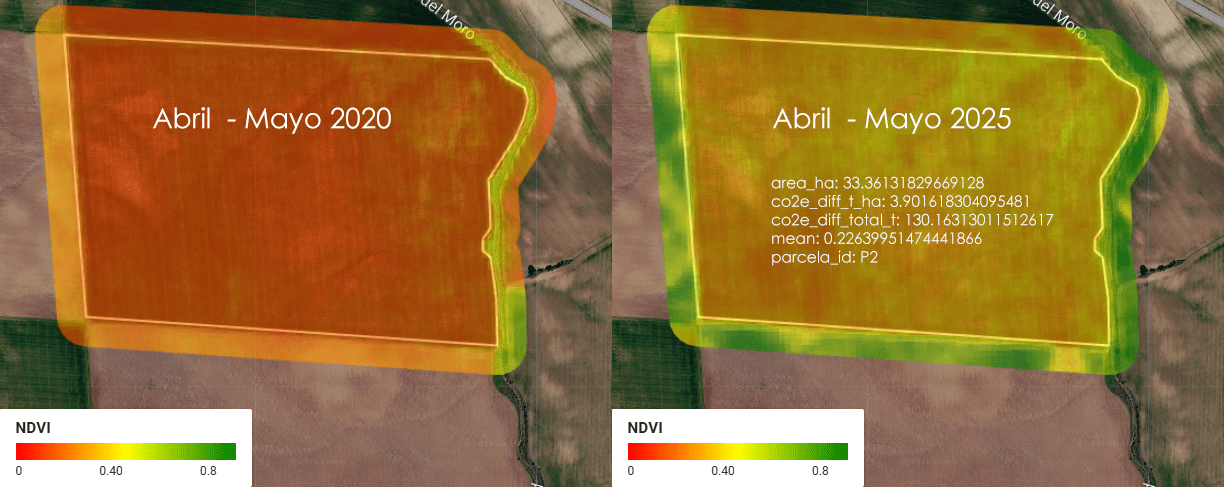
Imagina una empresa que se llama ACME. ACME es dueña de 5 parcelas de tierra en Almendralejo, Extremadura, España, donde se cultiva cereal (trigo, cebada, ese tipo de cosas). Entre las 5 parcelas, ACME tiene un total de 1.52 km² de tierra — para que te hagas una idea, eso es más o menos el tamaño de 300 campos de fútbol (a rzón de aproximadamente media hectárea por cada campo).
Start · Engage · Match. Un simulador de compatibilidad social en un bar de verdad (sin decirse ni una palabra)
Start Engage Match es un simulador interactivo, autocontenido en un único archivo HTML/JavaScript, que modela cómo un grupo de personas con gustos, orientaciones y niveles de paciencia distintos se cruza en el espacio físico de un bar y, en determinadas condiciones, genera afinidad y —ocasionalmente— una conexión completa («match»).
A lo largo de este documento, la aplicación y el local que representa comparten un único nombre: Start · Engage · Match, que además describe con precisión sus tres fases —se pulsa Empezar, se produce el Engage al cruzarse dos personas, y algunas veces surge el Match—.
El sistema combina cuatro capas de simulación que se ejecutan en tiempo real sobre un lienzo (canvas) de 20×20 metros: un modelo espacial del local (barra, pista de baile, zonas de sofás), un modelo de comportamiento individual (movimiento hacia puntos de interés, paciencia, abandono), un modelo de interacción social (el «engage» o encuentro, con una capa de compatibilidad y una capa de atracción física aleatoria) y un modelo temporal y económico que reproduce el ciclo de una noche real de bar, de 17:00 a 05:00.
El resultado se expresa como una animación en vivo, un panel de estadísticas con métricas de negocio (ingresos, coste por match) y un registro narrativo de los encuentros completos, generado automáticamente.
SolarScope: cuando el catastro, el LiDAR y el sol se sientan a la misma mesa
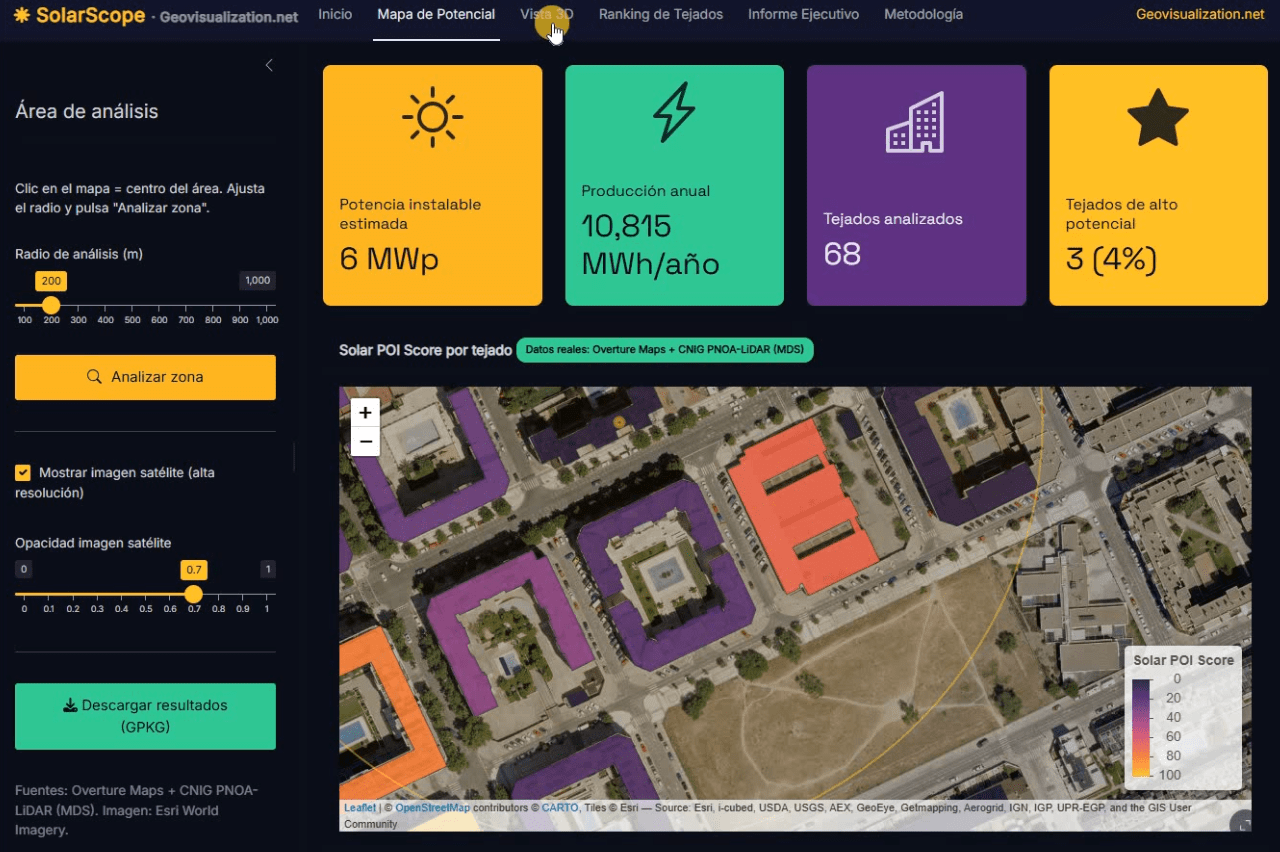
Llevo unos días dándole vueltas a una idea que, en el fondo, es bastante sencilla: si tenemos la huella de cada edificio, su altura y un modelo digital de superficies de alta resolución, ¿por qué seguimos viendo estudios de potencial solar que tratan los tejados como manchas homogéneas sobre un mapa? De esa pregunta, y de unas cuantas sesiones intensas de R, ha salido SolarScope, una aplicación Shiny que estoy desarrollando para hacer scoring de potencial fotovoltaico tejado a tejado, con datos abiertos y un flujo que se puede reproducir tanto en España como en Estados Unidos.
Time Series Analyzer: Análisis multitemporal de índices espectrales en Google Earth Engine
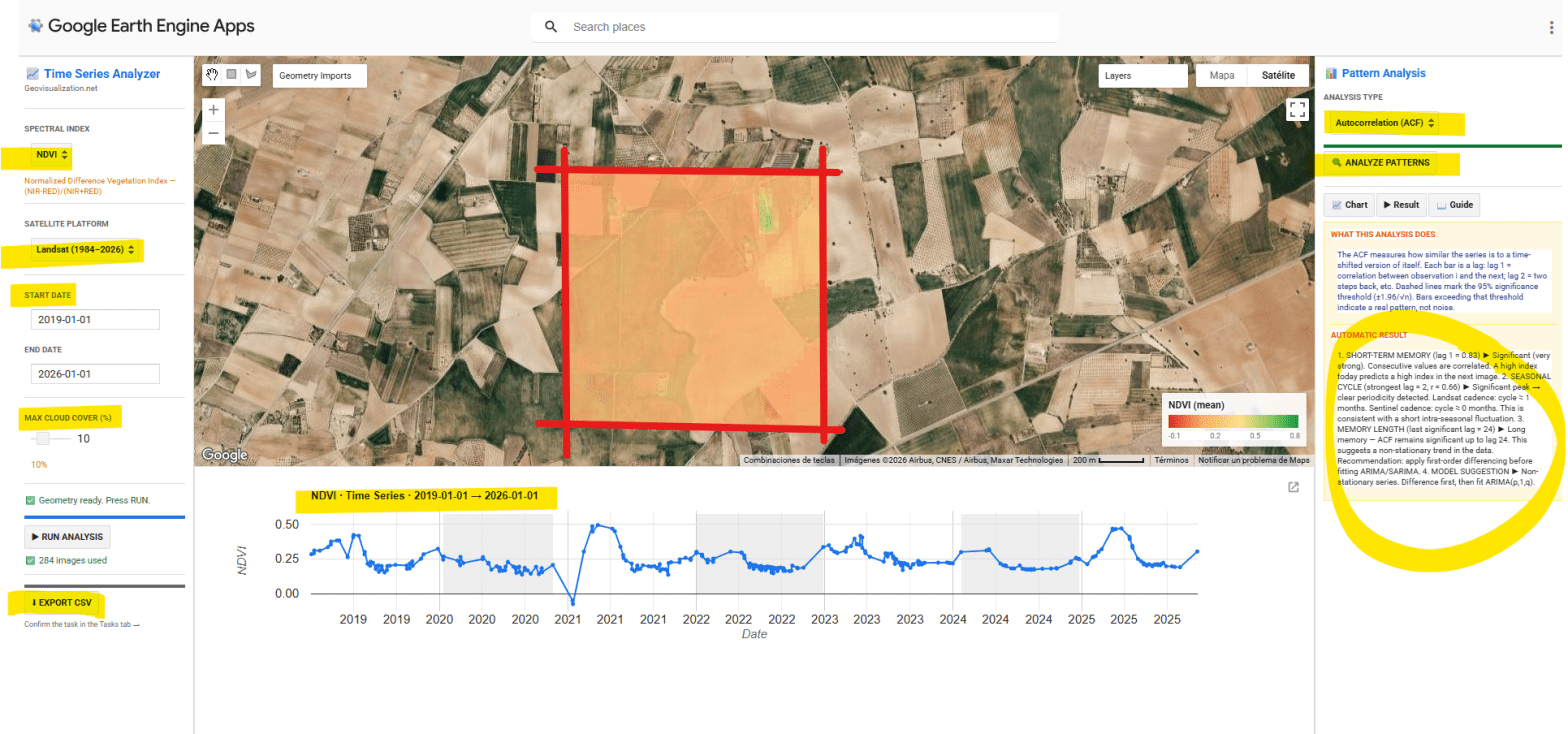
He desarrollado una aplicación interactiva en Google Earth Engine para la extracción y análisis estadístico automático de series temporales de cinco índices espectrales (NDVI, EVI, SAVI, NDWI y NBR) sobre cualquier geometría definida por el usuario en cualquier sitio del mundo. El objetivo es pasar de una imagen satélite puntual a una comprensión temporal del territorio: qué ha pasado, qué patrón subyace, y qué cabe esperar.
POI Intelligence for Urban Asset Analysis in RStudio: assetIQ
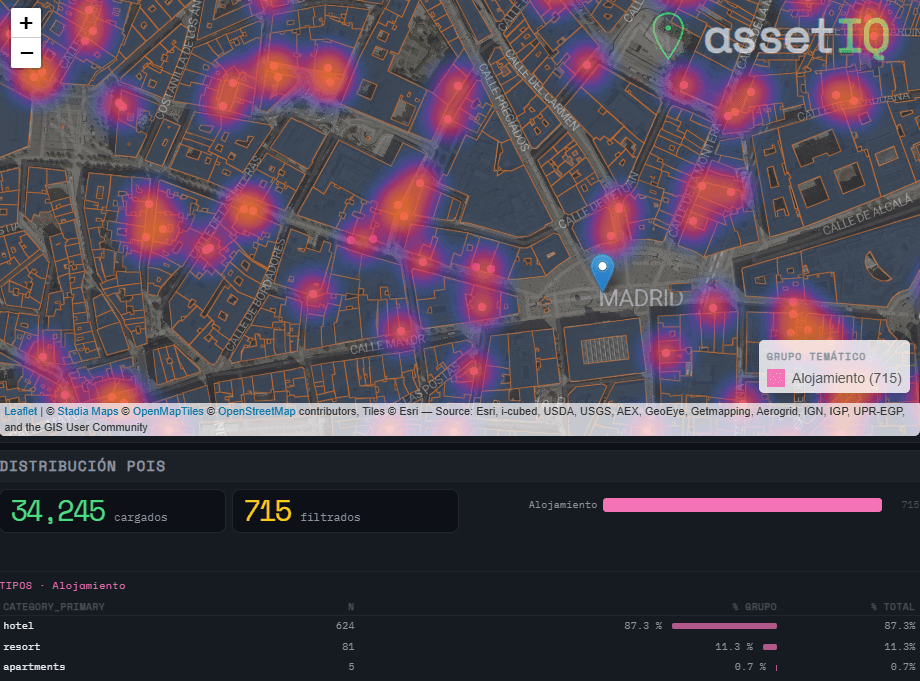
When analysing urban assets, there is genuine value in moving beyond generic neighborhood scores. The density of a coffee shop cluster, the proximity to a financial hub, or the concentration of accommodation around a transport node are signals that traditional datasets flatten into averages — or ignore entirely. assetIQ was built to change that. assetIQ is an R application powered by DuckDB and Overture Maps that extracts, classifies, and scores Points of Interest (POIs) for any location on Earth. You define a city and a search radius — from 100 meters to 25 kilometers — and the tool queries the Overture Maps Places dataset in real time, classifying each POI into thematic groups: Food & Drink, Retail, Health, Education, Transport, Accommodation, Financial Services, Leisure & Culture, Sport, and more.
The core output is an attribute value called POIQ: a normalized 0–1 score assigned to every building footprint within the area of interest, derived from a Kernel Density Estimation of the selected thematic group. A building in a dense retail corridor scores close to 1. An isolated residential block far from any commerce scores close to 0. This transforms thousands of individual points — which in raw form tell you very little — into a single, interpretable attribute per building, ready for downstream modelling, valuation, or site selection.
Detecting Potential Mobile Coverage Gaps Using OpenCellID, GHSL and Overture Maps: Case study over TUNIS
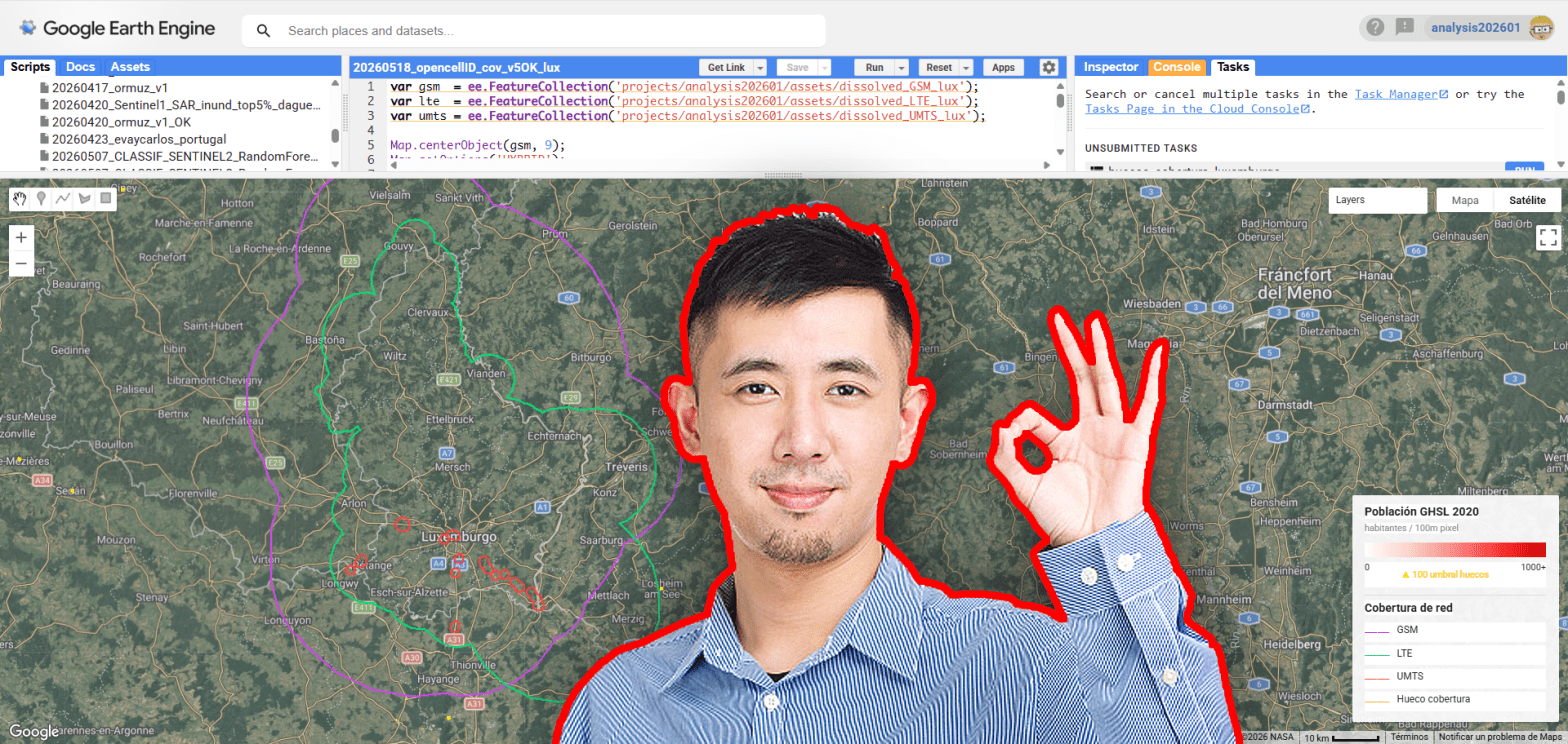
Mobile connectivity has become a fundamental component of modern infrastructure, yet significant spatial inequalities in network access still persist across both urban peripheries and rural environments. Using openly available geospatial datasets, this analysis explores potential mobile coverage gaps by combining OpenCellID cellular infrastructure observations, GHSL population layers and vector data extracted from Overture Maps. The objective is not to reproduce real telecom propagation models, but to generate a simplified spatial estimation of coverage capable of identifying populated areas potentially located outside the influence of nearby cellular infrastructure.

