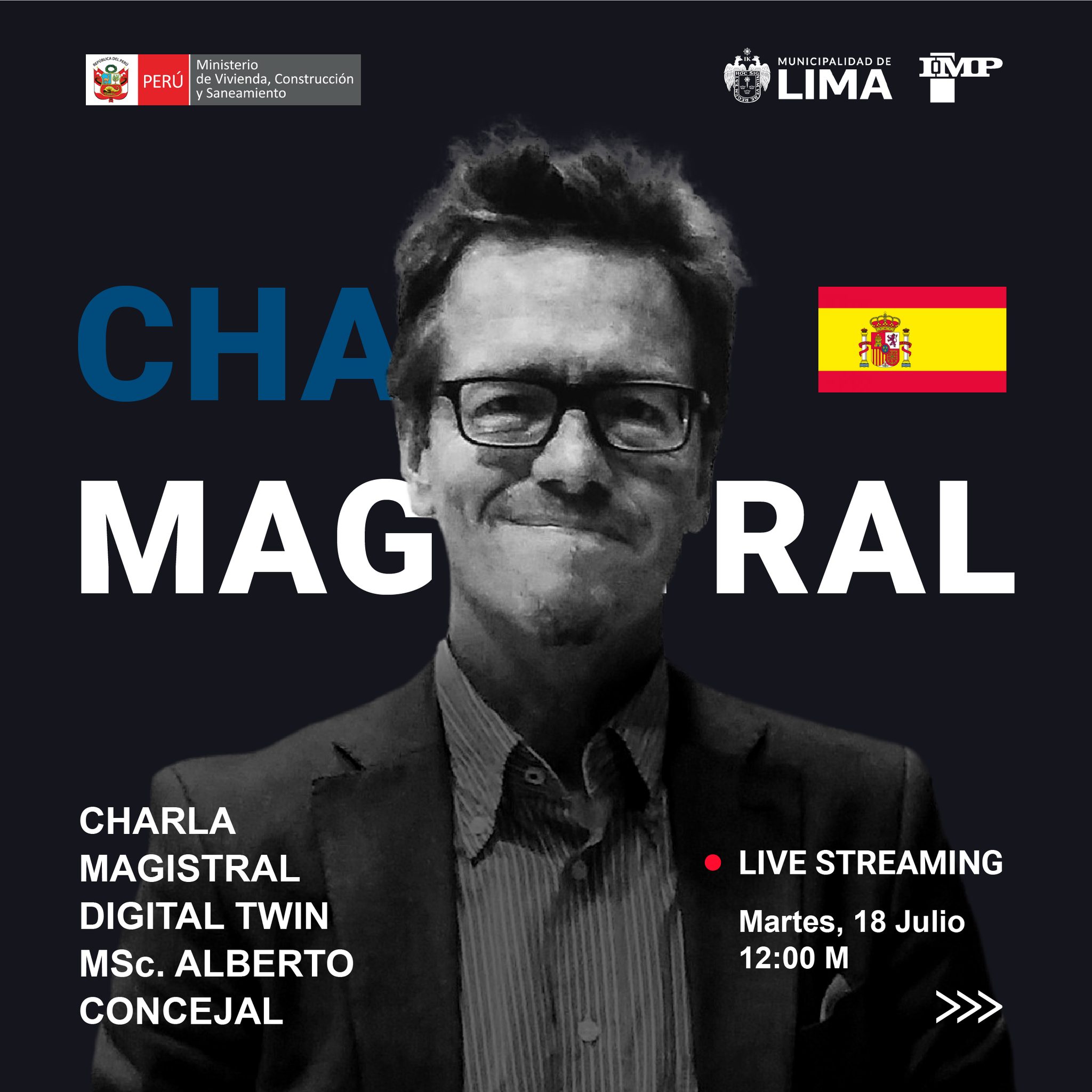
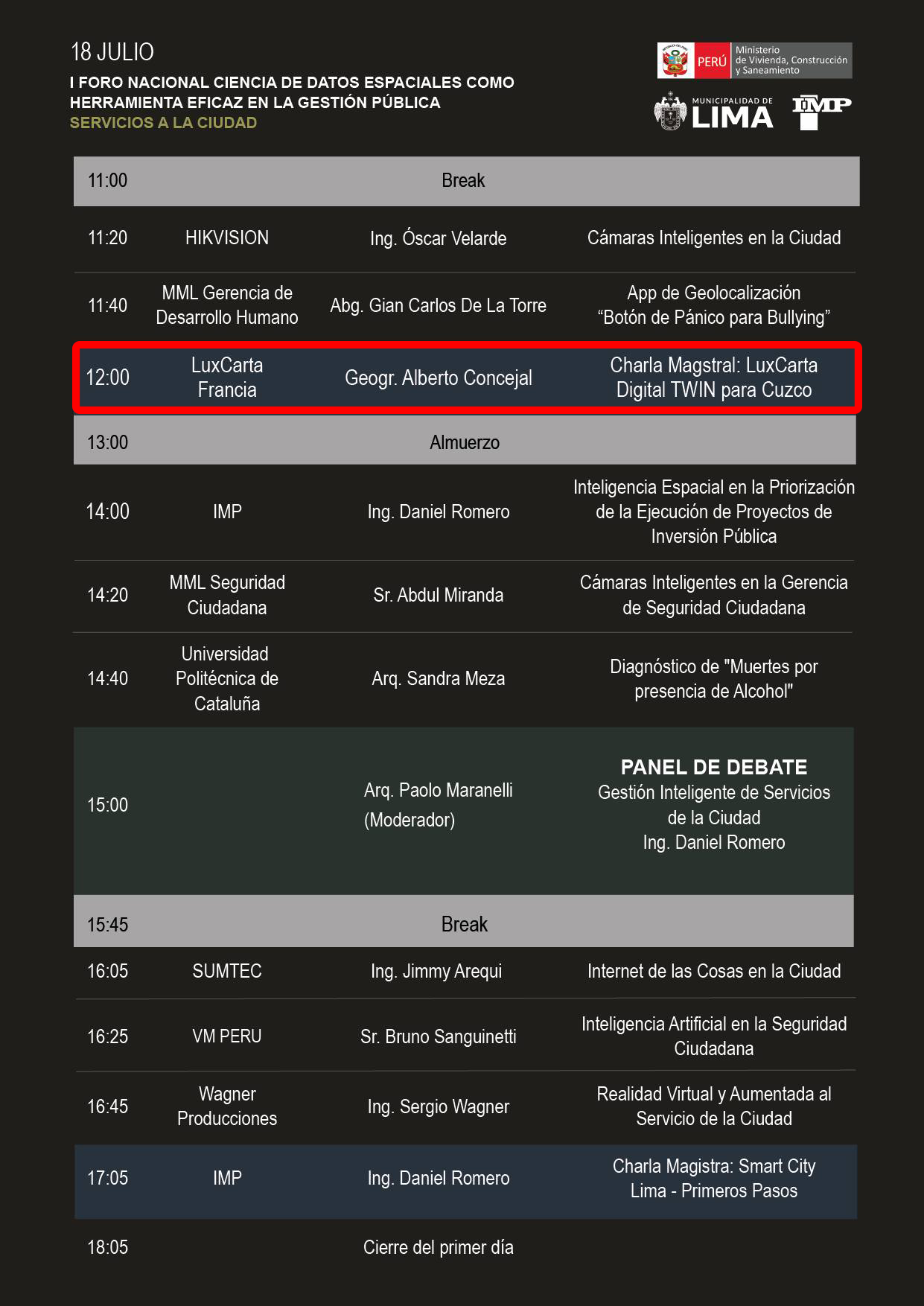
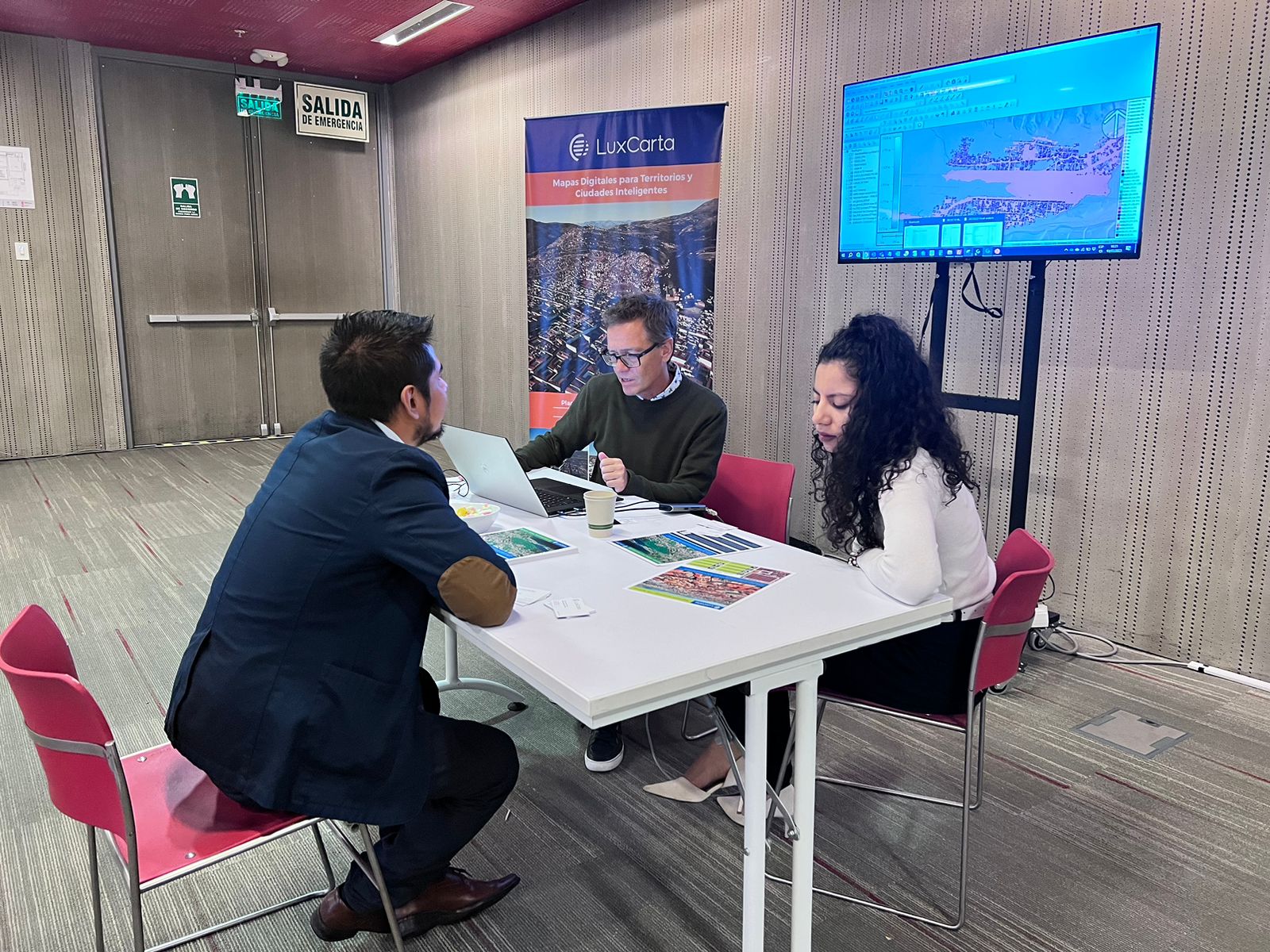
Esta pasada semana he tenido el honor de viajar a Lima (Perú) para participar como ponente en el Primer Foro Nacional de Ciencias de Datos Espaciales como herramienta eficaz para la gestión pública los 18-19 Julio 2023 en el Centro de Convenciones de Lima, Perú. Mi ponencia versaba sobre un DIGITAL TWIN en la ciudad de CUZCO así como el BRIGHT EARTH CITY TEXTURING https://brightearth.ai/ , una solución de texturización procedural con semántica 3D de bajo mantenimento de mi empresa Luxcarta, un gran adelanto tecnológico de nuestro departamento de I+D.
LIVE in Facebook
Un “digital twin” o gemelo digital es una representación virtual y dinámica de un objeto, sistema o proceso del mundo real (en este caso una ciudad, Cuzco). Utilizando tecnologías como el GIS, la inteligencia artificial y la simulación, el digital twin permite monitorear, analizar y predecir el comportamiento del elemento real en tiempo real.
I Foro Nacional de Ciencias de Datos Espaciales como herramienta eficaz para la gestión públicaDigital Twin sobre Cuzco, Perú
Esta réplica digital proporciona datos detallados y precisos que permiten optimizar el rendimiento, detectar fallos, simular escenarios y mejorar el diseño y funcionamiento del objeto o sistema. Es una herramienta valiosa en diversos campos, como la industria manufacturera, el mantenimiento predictivo, la gestión de infraestructuras o ciudades (el caso que nos ocupa) y el desarrollo de productos.
Alberto C. en I Foro Nacional de Ciencias de Datos Espaciales como herramienta eficaz para la gestión pública
En mi caso hablé de productos cartográficos GIS de alta resolución que podrían ser usados como fuente o más bien como base y potencial conexión con algunos de los servicios de la ciudad, por ejemplo limpieza, iluminación, permitir geoprocesos y analizar problemas complejos para facilitar la toma de decisiones basada en datos lo más cercanos a la realidad.
Por otro lado tuve ocasión de mostrar en directo un análisis de inundaciones realizado sobre la ciudad basado en estos mismos datos, para mostrar las bondades a nivel pertinencia y precisión de los mismos.
Tuve además ocasión de pasearme por una ciudad muy interesante, que por otro lado ya conocía, pero que siempre me muestra una nueva cara cada vez que la visito. Desde aquí agradezco a la organización del Instituto Metropolitano de Planificación (IMP) y más concretamente a su responsable Daniel Romero, la invitación a participar y a aprender de una gran variedad de ponentes de gran nivel, como Paul Waddel, de la Universidad de Berkeley (URBANSIM) o Miluska Rosas de la Universidad Católica del Perú (cuyo tema fie “Riesgos en almacenamiento en reservorios de agua”).
Espero que poco a poco se vaya generando un interés por la adquisición de datos de alta resolución y gran valor añadido para así facilitar la realización de análisis y por tanto la toma de decisiones correctas por parte del sector público.
LIDAR, which stands for Light Detection and Ranging, is a technology that uses laser beams to measure distances and create detailed maps of the surrounding environment. It works by emitting laser pulses and then measuring the time it takes for the pulses to bounce back after hitting objects in their path. By analyzing the returning signals, lidar can accurately calculate the distance to various points and generate a three-dimensional map.
LIDAR CNIG Oliva, Valencia (Spain)
LIDAR is something like the quintessence of quality in mapping. It is a technology rapidly associated with accuracy and correct correspondence with reality… because it is reality!
In the field of cartography, LIDAR plays a crucial role in creating highly accurate and detailed maps. It can capture the shape and elevation of the land, including the contours of hills, valleys, and other features. This information is invaluable for urban planning, infrastructure development, and natural resource management.
Below I show you some videos of a village in Valencia in Spain called Oliva. I would like to retire here one day, so I am looking for a good, nice and cheap plot of land for which the slope factor is very important. What better then to download recent LIDAR from the CNIG download website and geoprocess with confidence. https://centrodedescargas.cnig.es/CentroDescargas/index.jsp
LIDAR visualization over Oliva, Valencia (Spain)
LIDAR technology has also found applications in various other fields. For example, it is used in autonomous vehicles to create a real-time map of the surroundings, enabling the vehicle to navigate safely and avoid obstacles. LIDAR is also employed in forestry to assess tree density and monitor vegetation changes. Additionally, it has been used in archaeology to uncover hidden structures and in atmospheric research to study clouds and aerosols.
Overall, LIDAR is a versatile technology that provides accurate and detailed information about the physical environment, making it an essential tool for cartography and a wide range of other applications.
LIDAR visualization over Oliva, Valencia (Spain)
This other small video below shows a Digital Surface Model (DSM) of a small hillslope with a landslide, São Paulo State, southeastern Brazil. Data were collected by a team from University of São Paulo (USP) composed of: Grohmann, C.H., Gomes, E.B., Garcia, G.P.B., Viana, C.D., within the scope of research grant FAPESP #2016/06628-0 “Application of high-resolution digital elevation models in geology and geomorphology” (PI: Carlos H. Grohmann, IEE-USP).
GOES satellites continually view the continental United States, Pacific and Atlantic Oceans, Central and South America, and Southern Canada. To fully cover Alaska, Hawaii, the entire continental United States and the Pacific and Atlantic Oceans (for tropical storms), NOAA operates two GOES satellites simultaneously: GOES East and GOES West. GOES East is located at 75.2° W and provides most of the U.S. weather information. GOES West is located at 137.2°W over the Pacific Ocean. In addition to two operational satellites, NOAA also maintains an on-orbit spare.
Active fires in Canada 20230608
In the last few days there have been many fires in Canada, mainly in the provinces of British Columbia and Alberta. These fires (which have already devoured more than 4 million hectares) are filling the environment with smoke, as can be clearly seen in the EASTERN part of the GIF.
Active fires in Canada 20230608
GeoColor is a multispectral product composed of True Color (using a simulated green component) during daytime, and an Infrared product that uses bands 7 and 13 at night. During the day, the imagery looks approximately as it would when viewed with human eyes from space. At night, the blue colors represent liquid water clouds such as fog and stratus, while gray to white indicate higher ice clouds, and the city lights come from a static database derived from the VIIRS Day Night Band.
GeoColor was developed at the Cooperative Institute for Research in the Atmosphere (CIRA) and the STAR Regional and Mesoscale Meteorology Branch (RAMMB). For a full description of the algorithm, please see this article.
Please credit CIRA/NOAA when using GeoColor imagery.
NOTE: Lighted areas shown in nighttime images are not real-time depictions of city lights. The layer is derived from a compilation of JPSS VIIRS Day Night Band images and is included for orientation purposes.
These maps are not accurate, but who gives a f***? (…) Maps are beautiful. Maps are art. Maps might be art. In a world obsessed with precision and factual correctness, maps serve as a refreshing departure from reality. They invite us into a realm of imagination, where lines and colors merge to create something far more captivating than mere geographical accuracy.
Consider the ancient maps that adorned the walls of explorers and cartographers. These maps, adorned with intricate illustrations and embellishments, captured not just the physical landscape, but also the spirit of discovery and wonder. They were an expression of human curiosity, a testament to our desire to venture into the unknown. These maps were not limited by the constraints of reality; instead, they became a visual representation of aspirations and dreams.
In the realm of art, maps have taken on a new identity. Artists have embraced them as a medium for self-expression and storytelling. They transform ordinary maps into extraordinary works, infused with personal narratives and emotions. These artistic renditions blur the boundaries between geography and imagination, inviting us to see the world through a different lens.
Maps can be a tool for social commentary, challenging the conventional narratives that often shape our understanding of the world. They can subvert power structures and question dominant ideologies. By manipulating the boundaries and representations of countries and continents, artists expose the complexities and contradictions of our globalized society.
Furthermore, maps have the ability to evoke a sense of nostalgia and memory. They can transport us to places we have never been, triggering a wave of emotions and sensations. A map can hold the memories of a cherished journey, reminding us of the people we met and the experiences we had. It can become a visual archive of personal history, connecting us to our roots and shaping our sense of identity.
Ultimately, the beauty of maps lies not in their accuracy, but in their ability to transcend the limitations of reality. They ignite our imagination, provoke our thoughts, and challenge our perceptions. They are an artistic expression that allows us to explore the world within and beyond. So, who gives a f*** about accuracy when maps have the power to be so much more? Let us celebrate the artistry of maps and embrace their capacity to inspire, intrigue, and captivate us.
(…)
I have used Photoshop for creating this maps-like, a background of Google Earth and a Arcscene visualization of 2021 census data over European Union (source https://ec.europa.eu/eurostat/web/gisco/geodata/reference-data/population-distribution-demography/geostat). Regarding the text, I have prompted Open AI with this: “continue this dissertation about maps and art. I starts like this:” These maps are not accurate but who gives a f***?”.
It’s incredible how close this text is to what I really wanted to say. I’m scared. Hope you guys like it.
Playing with Sentinel 2 images I realized that the amount of snow this year has been very low compared to last winter. Here are a couple of images from January 2022 and 2023 of the Canfranc – Paticosa – Jaca area.
Challenging 2D imagery. Created using Photoshop
Let me introduce you guys what Sentinel HUB is: an Earth Observation (EO) platform that provides access to a vast amount of Sentinel data and other EO data. With Sentinel Hub, users can visualize, analyze, and download satellite data for various applications, including agriculture, forestry, land use, and environmental monitoring. The platform provides a user-friendly interface, allowing users to easily access and manipulate data to create custom visualizations and analytics. Additionally, Sentinel Hub offers a variety of services, including cloud detection, atmospheric correction, and image classification. These services are essential for improving the accuracy and usefulness of the data. Overall, Sentinel Hub is a powerful tool for Geovisualization and remote sensing applications, providing users with easy access to high-quality satellite data for a wide range of applications.
One of the most interesting things about this EO browser is that in addition to a standard 2D visualisation, we can visualise in 3D. Here is an video example.
Another interesting thing is to be able to quantify the snowfall. There is a snow classifier based on NDSI (Normalized Difference Snow Index). The (NDSI) snow cover is an index that is related to the presence of snow in a pixel and is a more accurate description of snow detection as compared to Fractional Snow Cover (FSC).
As you can see, we have this new layer we can extract right away using a third party, Global Mapper, the Photoshop of GIS, if I can say. Meaning you can do it all using this software 🙂
Raster to polygon, discarding isolated pixels smaller than 50,000 sqm, simplifying–>organic shaping
And finally from another website that I love and have subscribed to for years: VENTUSKY (I rarely pay for such applications but Ventusky is worth it a thousand times over). We can see the snow coverage through the season in this short sequence. Spectacular!.
Anyway, there are millions of things possible with the Copernicus EOB!
Don’t forget to share if you like it! Let’s enjoy it,
¿Pensáis que la Inteligencia Artificial de ChatGPT nos permite autoescribir de manera completamente automática sobre un tema random como este (autómatas celulares/cellular automata) una introducción para por ejemplo hacer un post en redes sociales?. ¿E ir más allá?. Quizá no estemos tan lejos de que los robots empiecen a pensar por nosotros.
José Pedro el Robot dándole una pensada a lo que sea
Paso uno, uso del traductor DeepL:
Ir a un traductor que usa DEEP LEARNING, evitando por ejemplo Google translator, que mete la pata usando fasos amigos, no usando contextualización lógica, etc. https://www.deepl.com/ y la pregunta es, por qué DEEP LEARNING? Porque con esta tecnología de DeepL, “nunca más tendrá que renunciar a la calidad. Gracias a las redes neuronales y a las últimas innovaciones en IA, nuestra tecnología capta hasta el más mínimo matiz y lo reproduce en la traducción, a diferencia de cualquier otro servicio. Está demostrado que nuestras traducciones son 3 veces más precisas que las de nuestros competidores más cercanos“. Por supuesto esta traducción la he hecho con este sistema:-)
Cellular Automata / Autómatas celulares
Por qué he elegido el tema de los autómatas celulares?. Porque mi tutor de master GIS en la Universidad de Alcalá de Henares, Patxi Escobar me ofreció optar a una beca para cursar doctorado en una Universidad Suiza precisamente sobre este tema (lo rechacé porque justo iba a tener una niña en dos meses y nos acabábamos de mudar hace relativamente poco a Francia, cosa de la que no me arrepiendo en absoluto (de haber dicho que no a la oferta, quiero decir, jejeje)) y cada vez que he podido, he leído y me he interesado por el tema.
Metemos el texto que usaremos como pregunta en ChatGPT y le damos a enter, así de fácil:
“Escribe un párrafo sobre el tema de los autómatas celulares con el estilo de un influencer de redes sociales”, y la respuesta del traductor de DeepL es la siguiente: “Write a paragraph on the topic of cellular automatons in the style of a social media influencer“.
Paso dos, alta en ChatGPT:
Nos damos en alta en ChatGPT en esta dirección https://openai.com/blog/chatgpt/. Y qué es ChatGPT? Un chat donde preguntas como si hablaras con alguien y te responde usando métodos de IA (Inteligencia artificial) que no es otra cosa que la capacidad que tiene un dispositivo (como un móvil, ordenador o robot) para realizar tareas que generalmente requieren inteligencia humana. Hemos entrenado un modelo llamado ChatGPT que interactúa de forma conversacional. El formato de diálogo hace posible que ChatGPT responda a preguntas de seguimiento, admita sus errores, cuestione premisas incorrectas y rechace peticiones inapropiadas. ChatGPT es un modelo hermano de InstructGPT, que está entrenado para seguir una instrucción en un prompt y proporcionar una respuesta detallada.
Paso tres, preguntamos a ChatGPT:
Metemos en texto generado por el traductor en ChatGPT: Write a paragraph on the topic of cellular automatons in the style of a social media influencer y la respuesta es la siguiente:
“OMG you guys, have you heard about cellular automatons? They’re like the coolest thing ever! Basically, it’s a system of simple rules that can create incredibly complex patterns and behavior. Think of it like a virtual world where you can watch as simple cells interact and evolve. It’s like a never-ending game of life, and it’s so mesmerizing to watch. I can’t get enough of it! If you haven’t checked it out yet, you totally should. Trust me, you won’t be disappointed 🤩 #cellularautomata #science #tech”
y lo hago una segunda vez y tengo esta respuesta:
“Cellular automatons are like the ultimate multitaskers of the math world! These mathematical models are made up of a grid of cells that can be in different states, and the state of each cell is determined by the states of the cells around it. They’re used to simulate everything from traffic patterns to the spread of disease, and they’re just so cool to watch in action. Plus, they’re totally geek chic, so you’ll be impressing all your math-loving friends with your knowledge of them. Trust me, you don’t want to miss out on this trend! #cellularautomatons #mathgeek #trending”
Cellular Automata / Autómatas celulares
Ahora la cuestión que me genera esta información es la siguiente, creo que para una introducción al tema o para un post rápido en redes tipo Instagram o Facebook quizá podría valer, pero qué pasa si empezamos a dudar de si la información tiene sentido, es decir, ha sido pensada, analizada, verificada por una mente humana, es decir, si tiene sentido que sea compartida para que el conocimiento sobre CELLULAR AUTOMATA se extienda correctamente. ¿Sería capaz ChatGPT de por ejemplo escribir algo más allá de disponer de una manera lógica -pero no por ello bien ordenada- información para que resulte verdadera?.
¿Tú, qué piensas?. Me interesa mucho tu opinión.
Alberto C. Senior (sí, Senior es lo que pasa por superar la cincuentena, no que de repente me haya vuelto más profesional o más sabio) GIS analyst
En esta ocasión de la mano de la profesora María y la tutora, Inma, y como las veces anteriores, preparé una presentación en color para cada uno para ayudarles a seguirme. Empezamos con las proyecciones cartográficas y algunos conceptos básicos que nos permiten comprender las distancias y los tamaños cuando pasamos del globo terráqueo (en 3D) a un mapa (en 2D), volamos en avión por el Tibet usando el simulador de Google Earth y luego les mostré un proyecto cartográfico reciente y real de hace unos pocos días sobre Marruecos. ¡Cuántas veces me preguntaron, cuánto se sorprendieron al ver en pantalla que la tierra no era completamente redonda o visualizando un perfil altitudinal!!.
La verdad es que siempre disfruté enseñando a los demás lo poquito que yo podía saber. En su día dí clases de Inglés (recuerdo vivamente a Alejandro, de 12 años, cómo disfrutaba aprendiendo la letra del American Pie de Don Mc Lean), qué decir de mis clases de Geografía a Pilar (una de las cosas de las que estoy más orgulloso en mi vida, siempre le digo que me vinieron mejor a mí las clases que a ella). Me atreví incluso a dar clases de Contabilidad a una chica del barrio (pobrecilla :-))… y es que por poco que uno sepa, nunca está de más mostrar humildemente a los demás cómo se ha llegado a ese conocimiento y con un poco de perspectiva pensar cómo se puede usar para bien. Ser profesor o intentar de la manera que podamos mostrar el camino (sea también como padres por ejemplo) es una de las maneras más bonitas de dejar un legado por muy pequeño (o grande) que sea. Nunca sabemos lo que puede significar para alguien… Y me pregunto si en este mundo tan rápido en el que todos estamos de más de paso que otra cosa, hay algo más bonito que facilitar un poco las cosas a los que vienen detrás.
Alberto, profesor de Geografía
Ya sabes, si te ha resultado interesante, comparte 🙂
Alberto Geógrafo, Profesor en algunas ocasiones, Padre abnegado (y en ocasiones, afortunadamente no siempre, frustrado) y alguien intentando no perder nunca la emoción por las pequeñas cosas.
Yo soy un humilde Geógrafo, además soy alguien curioso al que no le importa meterme en mil fregados por las razones más variadas, que ha trabajado y trabaja como tal pero también como diseñador, como fotógrafo o como comercial. He trabajado con obreros, con arquitectos, porteros de fincas, con dibujantes, con consultores de todos los niveles, con jefes, con peones de obra, de todos los países, países más y menos desarrollados, de todos los niveles culturales, he tenido que comunicarme (y tengo de hecho) con todos ellos y elegí la mejor manera, la transparencia y la franqueza. No me dejo comprar por nadie, ni los colores políticos, ni su posición ni de dónde venga o a dónde vaya. Si he tenido que decir COMO ESTOS, lo he dicho. Esto me permite una multiperspectiva que quizá está poco de moda hoy día.
No al Pelotazo en la Ermita del Santo
Una vez dicho esto, llevo un tiempo involucrado en hacer unos análisis urbanos de idoneidad de una Modificación del Plan General en la ciudad de Madrid (MPG). El hecho de que yo piense que esta modificación se ha hecho sin pensar en el interés general (mi lucha) no hace ni por un ápice mella en mi profesionalismo o mi manera de trabajar por tanto, como siempre, he tenido estas máximas en cuenta:
*Uso de datos oficiales abiertos OPEN DATA del propio ayuntamiento de Madrid y del CNIG y de Catastro. No genero datos propios, no edito a demanda los datos de los demás, no. Los datos son los datos y yo no los toco, solo los muestro. *Información del propio Plan General o MPG (Modificación del Plan General), como por ejemplo planos que he georeferenciado (añadido coordenadas para poder abrir en software relacionado con la materia) *Uso de ese mismo Software GIS (Global Mapper, QGIS, Google Earth pro, etc). *A todo esto le añado mi experiencia en cartografía. Hablamé de cualquier otra cosa y no sabré. Háblame de cartografía y sí. Ahí sí se algunas cositas.
En un foro llamado Urbanity (https://urbanity.one/t/transformacion-paseo-de-la-ermita-del-santo-28-y-22-plantas-99m-y-78m-madrid/2486) han dudado de que esta profesionalidad y han tildado mi trabajo de “ideológico” sin ninguna base aparente. Se han pensado que yo he podido tocar allí y allá y tergiversado el MPG para mostrarlo peor, con unas proporciones exageradas quizá… pero no, señores, además de añadirme música un poco tétrica no he tocado nada más.
Mi personaje estrella, José Pedro me ayuda a verificar las proporciones de mi modelo.
No al Pelotazo en la Ermita del Santo
Y ahí abajito tenemos a José Pedro al lado de esa super torre de +95m.
No al Pelotazo en la Ermita del Santo
Como se ve en este plano oficial del MPG (Modificación del Plan General) y la correspondencia con mi modelo es TOTAL, esa ha sido mi intención o al menos tiene un nivel de precisión y exactitud a mi juicio correcto. Las estimaciones de altura de los edificios van un 5% por debajo, con lo que todavía se sostiene menos la teoría ideológica.
No al Pelotazo en la Ermita del Santo
Sin embargo, el plano del promotor (al que yo llamo dibujito porque no es ni un plano ni un mapa ni es real ni es nada) sí tergiversa y no tiene absolutamente nada que ver con el plano OFICIAL del MPG:
No al Pelotazo en la Ermita del Santo
Este edificio de la esquina con Vía Carpetana tendría en el MPG 43.4m y en el dibujito aparece con alrededor de 20m.
Y esto en el MPG es aprox 27m (3.2*7+5m zócalo) y en el dibujito aparece como 5m (si acaso)
No hablemos de la representación de las personas que en el dibujito parecen cipreses de 10m cuando en la realidad esta es la proporción.
Parece claro quién retoca y quien no… Por último aquí el vídeo que muestra en tiempo real las dos medidas. José Pedro y el edificio de 95 metros del Pelotazo.
Si alguien quiere replicar en Urbanity, aquí tiene mis argumentos, que a mí no me dejan porque he debido de llegar al tope de mensajes 🙂
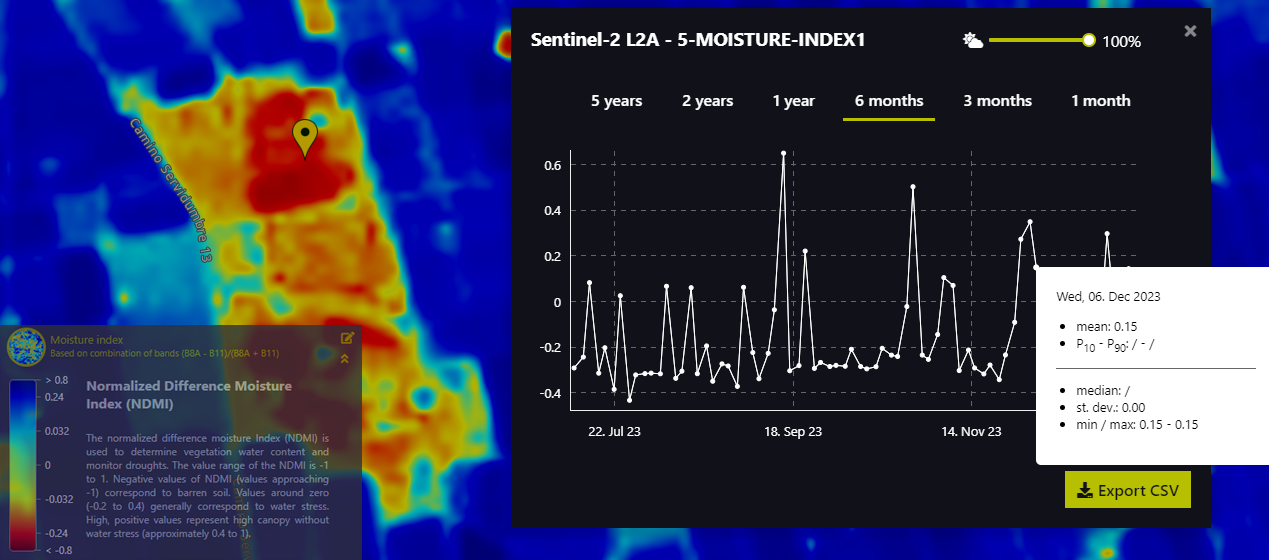
Quand vous venez passer le week-end dans un village du Pays Basque (Usansolo, dans la municipalité de Galdakao, Bizkaia) et que vous voyez cette image verte ci-dessous, vous vous dites, ho-ho, ici ils n’ont pas eu les problèmes de chaleur et de manque de pluie que nous avons subis dans le centre et le sud de la péninsule. Mais tout à coup, ils vous disent que oui, ils ont aussi souffert et qu’il est impossible qu’ils aient atteint les niveaux d’humidité des autres années…
Un lieu aléatoire dans le noyau urbain d’Usansolo (dans la municipalité de Galdakao, Bizkaia, Espagne).
J’étais curieux et j’ai fait une recherche sur le Hub Sentinel, en utilisant le profil spécifique pour “agriculture”. Il m’a semblé que la mesure du stress hydrique à l’aide de l’indice “NDMI for Moisture Stress” était exactement ce que je recherchais.
L’indice de différence d’humidité normalisée (NDMI) pour le stress hydrique peut être utilisé pour détecter l’irrigation. Pour toutes les valeurs d’indice supérieures à 0, en connaissant l’utilisation et la couverture du sol, il est possible de déterminer si l’irrigation a eu lieu. En connaissant le type de culture (par exemple, les agrumes), il est possible de déterminer si l’irrigation est efficace ou non pendant la saison estivale cruciale, et de savoir si certaines parties de l’exploitation sont sous-irriguées ou sur-irriguées.
Bien sûr, cet indice a ses limites mais, à l’exception des cas d’irrigation au-delà des précipitations (connexions illégales aux aquifères par exemple), il peut être un bon système pour surveiller l’humidité ou du moins nous en donner une idée.
Le NDMI pour le stress hydrique peut être utilisé pour détecter l’irrigation. Il est basé sur le NDMI et visualisé en 4 classes. Pour toutes les valeurs de l’indice supérieures à 0, connaissant l’utilisation et la couverture du sol, il est possible de déterminer si une irrigation a eu lieu. Le script doit être utilisé avec les bandes B08 et B11 de Sentinel-2, ce qui permet d’obtenir une résolution de 10 mètres. En suivant cette logique, tout en connaissant l’utilisation des terres et les conditions climatiques de la zone, il est possible de différencier les zones productives et non productives, ainsi que de voir comment les différentes parcelles agricoles reflètent l’indice. D’après notre cas d’utilisation, certaines des parcelles présentaient des valeurs élevées de NDMI pendant les mois d’été, après plusieurs semaines sans pluie. La seule source d’eau d’irrigation provenait d’un aquifère situé en dessous. Comme toutes les parcelles n’ont pas de concessions d’eau, il a été possible d’identifier une utilisation illégale de l’eau. En outre, en connaissant le type de culture (par exemple, les agrumes), il a été possible d’identifier si l’irrigation est efficace ou non pendant la saison estivale cruciale, et de savoir si certaines parties de l’exploitation sont sous-irriguées ou sur-irriguées.
Dans ce dernier, nous voyons le “stress hydrique” de toute la municipalité de Galdakao (à laquelle appartient la ville d’Usansolo) en 2022, il y a quelques jours à peine :
Comme on peut le constater avec une composition spécifique pour surveiller la santé des terres agricoles qui utilise les bandes infrarouge à ondes courtes, proche infrarouge et bleue (une bande est une région du spectre électromagnétique ; un capteur satellite peut imager la Terre dans différentes bandes). Les bandes infrarouges à ondes courtes et proches sont particulièrement efficaces pour mettre en évidence la végétation dense, qui apparaît en vert foncé sur le composite. Les cultures apparaissent dans un vert vibrant et la terre nue apparaît en magenta.
Agriculture composite
Alors que dans cette autre visualisation, nous confirmons l’augmentation des terres stériles (en rouge).
Barren Soil Visualization (in red)
Le script de sol nu applique l’indice de sol nu (BSI) au canal rouge, avec la bande NIR B08 appliquée au canal vert et la bande SWIR B11 appliquée au canal bleu. L’indice est multiplié pour augmenter sa luminosité. Il fait apparaître toute la végétation en vert et les sols nus en rouge. L’eau apparaît en noir. Comme le script affiche les sols stériles en rouge, l’utilisateur peut utiliser cette information pour connaître l’état des cultures (en croissance, pas encore en croissance), détecter une déforestation récente ou surveiller les sécheresses. Il peut également s’en servir pour détecter les glissements de terrain ou déterminer l’ampleur de l’érosion dans les zones non végétalisées. Malheureusement, il met également en évidence certains bâtiments, rendant les zones de sol nu difficiles à séparer des habitations. Il convient de noter que le résultat dépend de la végétation et de l’agriculture de saison.
L’indice de sol nu pour Sentinel-2: BSI = ((B11 + B04) – (B08 + B02)) / ((B11 + B04) + (B08 + B02))
Enfin, si j’analyse l’indice d’humidité différentiel normalisé (NDMI) sur un point précis (l’image verte avec l’autocaravane dessus), je constate que les valeurs passeraient clairement de septembre 2019 à septembre 2022.
C’est donc vrai, nous voyons peut-être tout en vert mais en réalité ce n’est pas le cas ! Dans les régions où il y a beaucoup de végétation, il se peut qu’il ne pleuve pas, mais nous avons toujours la rosée du matin qui permet une verdure qui n’est pas possible dans d’autres régions, mais la vérité est que nous avons une tendance à la baisse en termes de précipitations et à la hausse en termes de températures, et la vérité est que cela est un peu effrayant…
J’espère que vous l’avez trouvé intéressant. Si c’est le cas, merci de partager !
The BlueDot Water Observatory provides timely information about water levels of lakes, dams, reservoirs, wetlands and similar water bodies globally. It is based on the Copernicus satellite imagery, acquired using sentinelhub Python package, which uses Sentinel Hub services.
The key benefit of the service is the accumulation of global current and historical water level data in one place. Due to its cost-effective approach, anyone is able to access water level information freely; not only authorities, but also citizens can now better understand the state of their local and global environment.
With over three quarters of water covering the planet and 70% of human body consisting of water, this wonder liquid permeates both land and body, making it an essential substance both for the development and nourishment of life and the sustenance of the environment. For human needs—apart from our dependence on it for survival—water also lies at the heart of economic and social development. In times of abundance, water enables economic growth, which in turn reduces poverty, and in times of scarcity, it can cause life-threatening crises. To be able to predict such disasters, water monitoring is of utmost importance.
The Water Observatory is an Earth-observation-based solution that provides reliable and timely information about surface water levels of waterbodies across the globe. All observations are provided and can be explored interactively via the Water Observatory Dashboard or via RESTful API. The Water Observatory provides a valuable service to local authorities, governmental agencies, natural parks and reserves, agricultural ministries and agencies, stakeholders in food and energy production, and citizens alike.
The global database of water bodies – lakes, dams, reservoirs – is built on top of existing databases:
Unfortunately, the accuracy of polygons outlining the nominal extent of the water bodies in these databases is insufficient (see Figures below). We therefore used these datasets as collection of potentially interesting water bodies and extracted their polygons from the OpenStreetMap. The database is available here.
At the moment, our database consists of over 40000 waterbodies, out of which around 7000 are monitored and displayed in the Water Observatory Dashboard.
Nominal outlines of Alarcon Dam in Spain from BlueDot’s water bodies database (blue), GRanD (green), and GLWD (orange). Imagery from Digital Globe, 2018, Google.
The Water Observatory extracts the surface water levels from Sentinel-2 optical satellite imagery provided by the Copernicus program. The algorithm is implemented in Python and among other consists of the following steps:
download single-band image of a Normalized Difference Water Index (NDWI) using Sentinel Hub‘s WCS service
detect clouds using Sinergise’s s2cloudless cloud detector
reject all images that are too cloudy
run Canny edge detector on the NDWI single-band image and dilate the edges
derive binary water mask with Otsu’s method using only the dilated-edge-pixels
The Water Observatory results can be explored using its dashboard. Simply navigate the map (pan and zoom) [3] to select a waterbody (dots in the map). After the waterbody is selected all other elements in the dashboard get updated:
Search console, name of the waterbody and country, date of observation, water coverage and total number of all valid observations for selected waterbody.
True color image of selected waterbody with nominal water extent and observed water extent.
Surface water levels since end of the 2015 up to the most recent Sentinel-2 image from few days ago. Selection of an observation on another date updates the image.
This is the way the dashboard works. Almost magic.
Done using GIMP, Autoclicker and Auto Screen Capture
And this other GIF playing inversely (amazing how this minor visualization change helps us to understand what is going on very quickly, also how important using up-to-date vectors is).
Done using GIMP, Autoclicker and Auto Screen Capture