Dont get wrong if you see the IA background showing our handsome major almost showing his beautiful smile in Cibeles/Correos it’s only to get your attentions (only if you need it thou!). Flooding in urban environments is not a speculative hazard but something we can quantify. In the case of Madrid, the intersection of pretty mountainous terrain (it might surprise you there are 2000m difference between the highest spot in Madrid province, Pico Peñalara -2428m- and the Alberche river environment in some areas -430m-) and urban expansion presents a scenario of significant risk, particularly when analyzed through the lens of shared high-resolution geospatial data. This study integrates the buildings from BTN (Base Topográfica Nacional) provided by the Spanish “IGN”, the CNIG with the official flood hazard maps for a 100-year return period (T=100), published by the Ministry for the Ecological Transition and the Demographic Challenge (MITECO). The T=100 scenario is the most representative for evaluating long-term flood exposure, as it reflects events with a 1% annual probability—rare but not improbable, and certainly not negligible.
Category Archives: TERRAIN
Sentinel-1 SAR: Un aliado indispensable para el análisis y seguimiento de inundaciones – Derna, Libia (2023)
La gestión y monitorización de fenómenos hidrológicos extremos, como inundaciones repentinas o fallos estructurales en presas, representan un desafío crítico para los especialistas en geomática, hidrología y planificación territorial. En este contexto, la tecnología radar de apertura sintética (SAR) a bordo del satélite Sentinel-1 de la Agencia Espacial Europea (ESA) ofrece una capacidad sin precedentes para capturar información precisa y fiable sobre la dinámica superficial, independientemente de las condiciones atmosféricas y lumínicas.
Mapping My 10-Year Adventure: Running Madrid to Ulaanbaatar 10,127 km
In August 2014, I laced up my running shoes for the first time, with no grand expectations — just a simple desire to move, to feel better, to take control. I was far from athletic: weighing nearly 80 kilograms (almost 20 kg more than today), with no endurance, no rhythm, and definitely no running background (exception made of some runs in my mid 20’s :-)). But I made myself a promise: I would be stubborn, consistent, and patient. No matter the weather — rain, wind, snow, scorching heat, storms — I would run, three times a week, every week.
The Remarkable Visibility of Almeria’s Greenhouses from Space
In the sphere of Earth observation and remote sensing, the Almeria greenhouses stand out as an astonishing spectacle visible even from the edge of space, defined by the Kármán line at approximately 100 kilometers in altitude. This unique visibility is not only a testament to the vast scale of human agricultural activity but also a captivating example of the power of satellite-based remote sensing technologies.
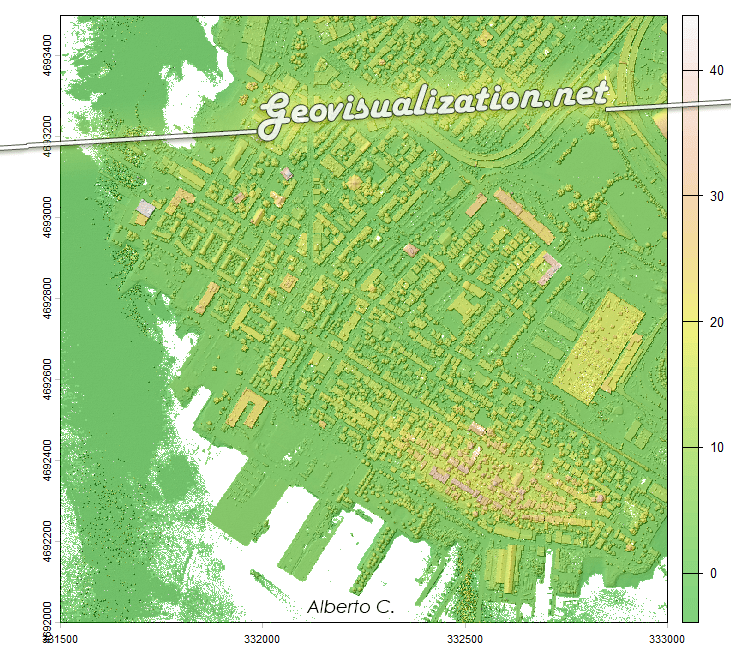
The beauty (and precision) of LIDAR:
Lidar, which stands for Light Detection and Ranging, is a technology that uses laser beams to measure distances and create detailed maps of the surrounding environment. It works by emitting laser pulses and then measuring the time it takes for the pulses to bounce back after hitting objects in their path. By analyzing the returning signals, lidar can accurately calculate the distance to various points and generate a three-dimensional map.
Measuring snow coverage using EOB – Earth Observation – Sentinel HUB
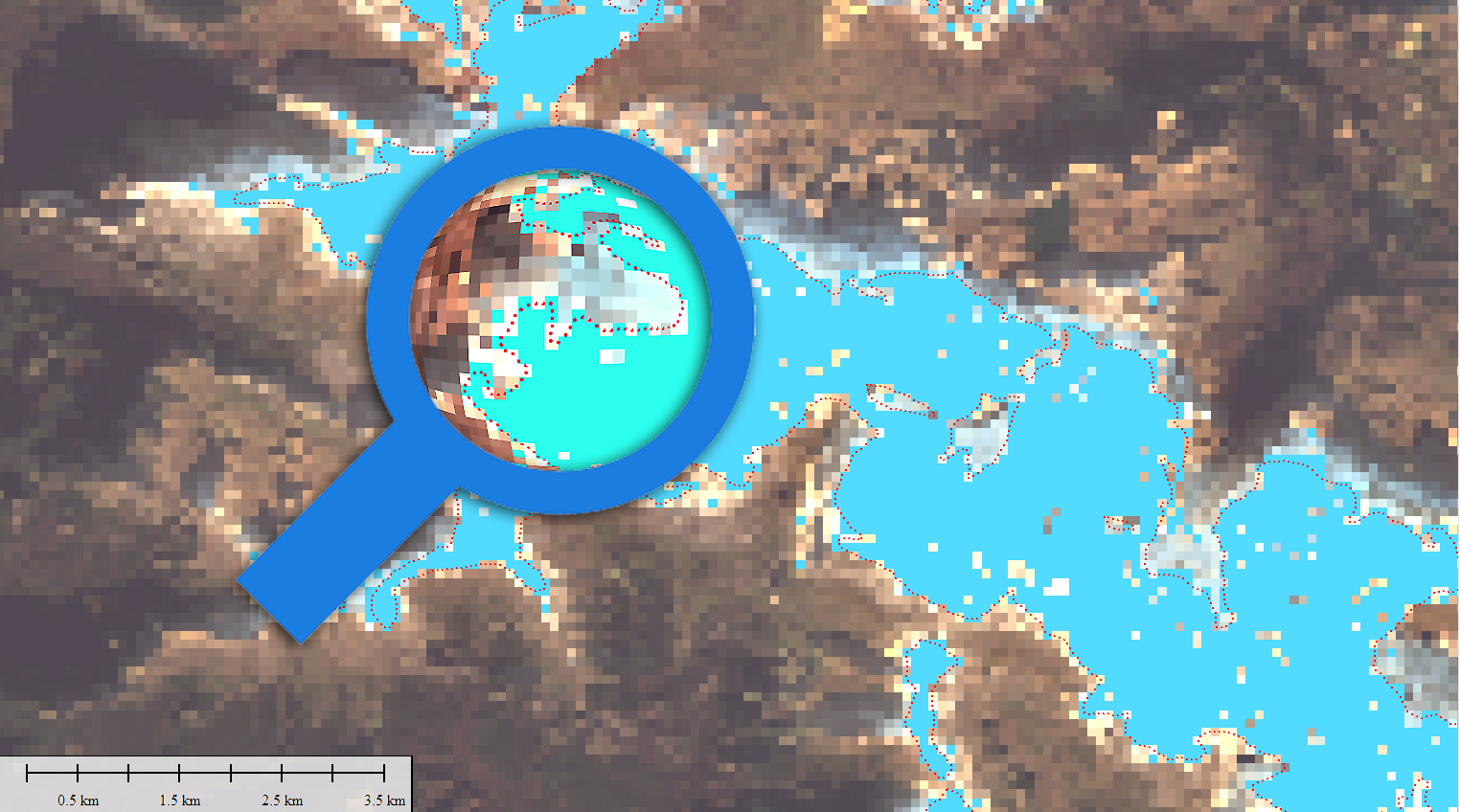
Playing with Sentinel 2 images I realized that the amount of snow this year has been very low compared to last winter. Here are a couple of images from January 2022 and 2023 of the Canfranc – Paticosa – Jaca area. One of the most interesting things about this EO browser is that in addition to a standard 2D visualisation, we can visualise in 3D. Here is an video example. Another interesting thing is to be able to quantify the snowfall. There is a snow classifier based on NSDI (Normalized Difference Snow Index, The Normalized Difference Snow Index (NDSI) snow cover is an index that is related to the presence of snow in a pixel and is a more accurate description of snow detection as compared to Fractional Snow Cover (FSC).
Inland Water levels… Globally. Copernicus did it again!
The Water Observatory is an Earth-observation-based solution that provides reliable and timely information about surface water levels of waterbodies across the globe. All observations are provided and can be explored interactively via the Water Observatory Dashboard or via RESTful API. The Water Observatory provides a valuable service to local authorities, governmental agencies, natural parks and reserves, agricultural ministries and agencies, stakeholders in food and energy production, and citizens alike.
¡Viento del Sahara en España! ¡Sí!
De repente se levanta uno y ve los coches, los marcos de las ventanas y las aceras llenos de arena… ¿Qué es esto?, ¡Uno quiere comprender más en detalle! Si esto es en Madrid, qué no ocurrirá en Murcia (que está de camino)!! 🙂 Lo cierto es que si tomamos las imágenes del SENTINEL 5P Aerosol index podemos ver cómo en esa longitud de onda encontramos aerosoles. ¡Y muchos! ¿Y hacia dónde se desplazan?. Directos al centro de la península.
Wildfires in the sub-Saharan region
This image, acquired by one of the Copernicus Sentinel-2 on 8 February 2022, shows ongoing wildfires in the Boma National Park in South Sudan. Fires are common at this time of year in the sub-Saharan region.