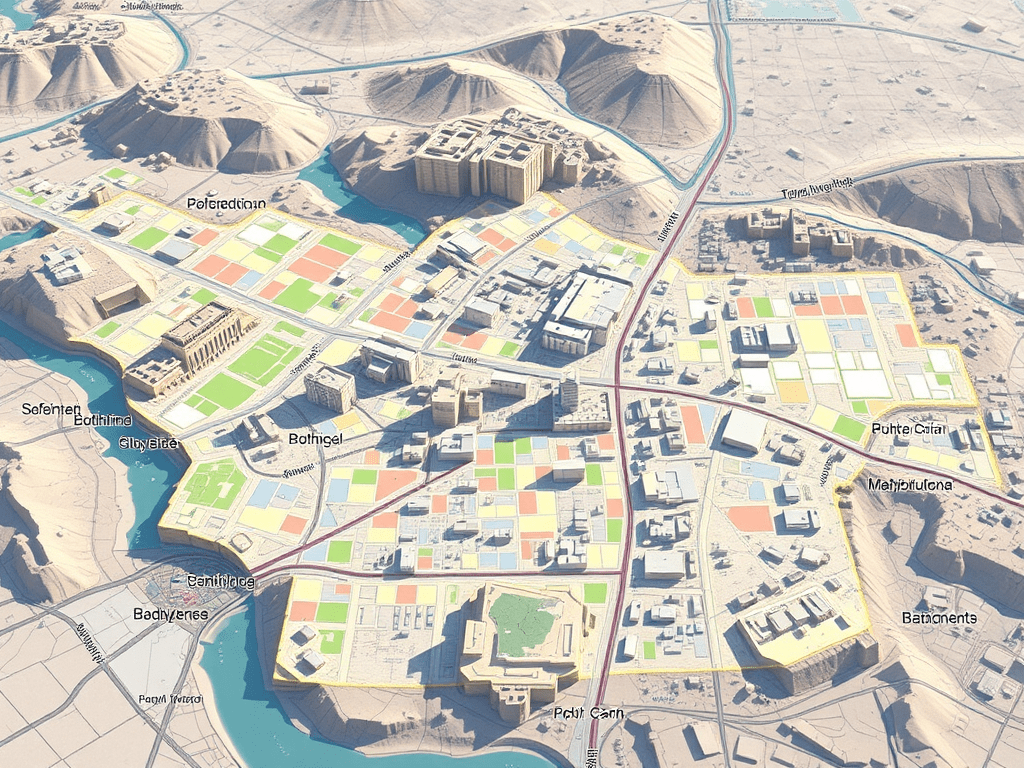
As a geographer working with Geographic Information Systems (GIS), I am particularly interested in exploring urban delineation methods that move beyond the constraints of administrative boundaries. Instead of relying on official municipal limits—which can often be outdated or misaligned with functional realities on the ground—I focus on delineating urban areas based on physical indicators such as built-up surface, population density, and spatial continuity. This approach allows for a more accurate and dynamic understanding of urban space.

One of the key advantages of this method is its adaptability. By combining high-resolution built-up surface data (i.e., GHSL) with recent population datasets (i.e., WorldPop or census microdata), we can define urban extents that are responsive to real-world conditions. Furthermore, the inclusion of additional variables—such as land use intensity, night-time lights, or accessibility metrics—makes it possible to tailor the definition of “urban” to specific research questions or policy needs.

// Filling small holes inside urban delimitation
var urbanClean = urbanMask
.focal_mode(9, 'square', 'pixels')
.focal_max(9, 'square', 'pixels');
All spatial processing and analysis have been conducted using Google Earth Engine (GEE), which offers a powerful cloud-based platform for geospatial analysis at scale. GEE enabled the seamless integration of multi-source datasets, temporal filtering, and the application of spatial operators for morphological transformations, such as focal operations to fill small gaps between built-up patches. This helped to consolidate fragmented urban geometries and ensure spatial continuity, particularly in rapidly expanding or sprawling urban areas.
// Applying urban threshold (i.e, values > 90 are considered urban)
var urbanMask = built.gt(90);
Map.addLayer(urbanMask.updateMask(urbanMask), {palette: ['red']}, 'Binary Urban Zones');
This kind of urban delineation has a wide range of potential applications. One immediate use case is to estimate the population covered by a given technology—such as 4G or 5G mobile networks—by overlaying coverage maps with these data-driven urban extents. However, the implications go far beyond telecoms. The method can support infrastructure planning, health service accessibility analysis, risk exposure assessments, and urban resilience studies.
In particular, using these refined urban boundaries allows us to model service delivery or environmental exposure more precisely than would be possible using administrative units alone. For example, in the context of climate adaptation, being able to identify the true spatial footprint of an urban area is critical for assessing urban heat island effects or planning green infrastructure interventions.

Ultimately, this approach contributes to a more flexible and analytically powerful framework for understanding urban dynamics—one that reflects the lived reality of urbanization rather than the often arbitrary lines drawn on a map.
I have performed all tests using Global Mapper 26.0, Google Earth Pro.
I herewith add the direct link to GEE where you guys can test it right away!!!
https://code.earthengine.google.com/5f74c4f82c17ac8ae3ade4a1d7974589
Please test it and let me know about it!!!
Alberto C
Senior GIS analyst and Open Data Evangelist
https://code.earthengine.google.com/
https://developers.google.com/earth-engine/datasets/catalog/JRC_GHSL_P2023A_GHS_BUILT_S?hl=es-419
https://developers.google.com/earth-engine/datasets/catalog/WorldPop_GP_100m_pop
 Geovisualization.net