
It is a fact that a betting shop (AKA bookmaker in UK or bookie in the US) should not be close to a secondary school. Its obvious the impact on population ranging something like 12-18 could be higher than in other age thresholds. How close? 100m? 300m? 500m? Euclidean distance (a straight line) or following the street network?. In any case, if I decide choosing for instance a range of 500m, for example, 81% of betting shops in Madrid have secondary schools within that distance (258 out of 316). Looking at it from the secondary schools’ point of view, almost 60% of secondary schools have betting shops within 500m (171/291). This is undoubtedly an issue that needs to be addressed.


The spatial analysis reveals a moderately negative correlation (r = -0.39) between the distance to the nearest betting shop and the number of betting shops within a 500-meter radius of each secondary school. This means that, on average, the shorter the distance between a school and the nearest betting house, the greater the number of betting houses found within a short walking distance (for example, within 500 meters). In other words, schools that are close to one betting house are very often close to several. Conversely, schools located farther from any betting house tend to be in areas where these establishments are much less common or even absent. This pattern does not imply a perfect one-to-one relationship — some exceptions exist — but the overall trend is clear: betting houses are not randomly distributed in the city. Instead, they tend to form clusters, and those clusters often appear in the same parts of the city where many schools are located. Although the relationship is not perfectly linear, it might indicate a potential spatial association between the two types of locations.

From the heat map, this relationship becomes more tangible. 171 out of 291 secondary schools in Madrid — approximately 60% of the total — are situated within 500 meters of at least one betting shop. The density surface highlights four clear hotspot zones: Usera, Carabanchel, Centro, and Tetuán. These districts concentrate the majority of the spatial overlap between High Schools and betting shops , forming well-defined high-intensity clusters. The pattern aligns with socio-economic and demographic realities: these are traditionally dense urban districts with younger populations and, in several cases, lower average income levels, which have historically attracted a higher concentration of gambling venues.

By contrast, the richest districts — such as Salamanca, Retiro or Chamberí — show a more dispersed and lower-intensity pattern. This uneven distribution reinforces the idea that the proximity of betting shops to High School educational institutions is not random, but rather follows a spatial logic influenced by the urban and social fabric of the city.
In practical terms, the combination of a negative correlation and the hotspot clustering suggests that High Schools and betting shops in Madrid exhibit a clear spatial association. The proximity of many High Schools to gambling establishments may have implications for urban planning, youth protection policies, and spatial regulation of gambling activities. The results provide a quantitative foundation for further policy discussions on how the city’s gambling landscape interacts with its educational network.

Methodology: Open Data Madrid provided ‘Censo de locales, sus actividades y terrazas de hostelería y restauración. Histórico’ which I cleaned and cross-referenced to obtain the venues dedicated to gambling and having an active licence (2020). Then I downloaded Madrid High Schools (those offering public and private secondary education). Based on Madrid districts I was able to measure distances and highlight the most affected areas. I used GEE to performed the Pearson Correlation (you have the code below). Maps where created using Global Mapper v26.2.

What if I can get a GeoJSON just by feeding the system with the required threshold? (i.e this code returns the 171 secondary schools in Madrid which have betting houses closer than a 500m radius from them). It’s crazy 171/291!! (almost 60%)?:
https://code.earthengine.google.com/e15e0ee2c0269d8b3e4a199d444620d3

TRY IT YOURSELF!!!
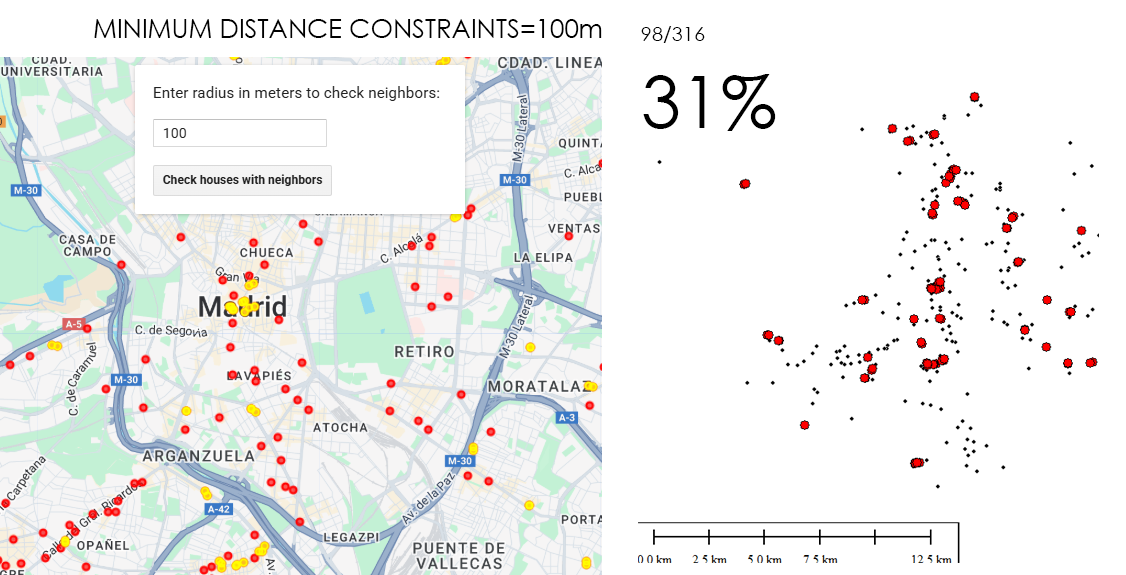
What if I can get a GeoJSON just by asking the minimum distance to each other? (i.e this code returns the 98 bookies (betting shops) which are closer than 100m to other bookie?:
https://code.earthengine.google.com/662af463a6c4a4b3eca9d9dbcb6fd5fc
TRY IT YOURSELF!!!
Additional considerations:
The regulations governing the distance between betting shops and educational establishments such as secondary schools vary depending on the autonomous community. Some communities have implemented or proposed minimum distances, such as a 300-metre radius in some regional laws, while others continue to apply shorter distances or are in the process of reviewing their regulations. It is essential to consult the specific legislation of each community to find out the exact regulations and how they are applied. Examples of regulations by autonomous community (CCAA):
*Community of Madrid: Established a minimum distance of 100 metres between gaming halls and schools/secondary schools in 2019. Although extensions were proposed, the current regulation remains at 100 metres, with the possibility of some existing premises being exempt, according to El Mundo.
*Galicia: Its gaming law establishes a minimum distance of 300 metres from educational centres for new gaming establishments, increasing the previous linear distance of 150 metres, according to GaliciaPress.
*Andalusia: The proposal to extend the distance to 500 metres has been taken to Parliament, although the current regulation may be different, as reported in ABC.
*Other regions: Some cities, such as Talavera de la Reina in Castilla-La Mancha, have included a minimum distance of 300 metres, backed by court rulings, according to different sources.
Distance can be measured in a straight line or in radius, and this difference is important when applying the regulations.
Premises that were already in operation before the regulations were implemented in some regions are often exempt.
In the case of Madrid, proposals to ban betting shops from being located less than 500 metres from educational establishments have even been analysed, as reported by Telemadrid.
Sources:
https://gestiona.comunidad.madrid/wleg_pub/secure/normativas/contenidoNormativa.jsf?opcion=VerHtml&nmnorma=12618&eli=true#no-back-button
https://www.ordenacionjuego.es/
https://www.telemadrid.es/programas/cronicas-subterraneas/investigaciones/apuestas/programa-completo-2-2072812740–20181202113000.html
https://code.earthengine.google.com/3c977b75e9f966a7c0ec3a8dd96588c6?noload=true
Alberto C.
Geodata Analyst
 Geovisualization.net